Hue 3D
Hue 3D is next.
Hue 3D is not on sale yet: it will be priced, under its own licence, when it opens.
Hue Charts is available nowAt a glance
What of Hue 3D stands.
Lab experiment
Our current working example
The play pen: throw a ball into a court of balls, and reset it. We test our kernel, our process and the physics engine here, so it changes as we build.
Path-traced light
In the lab, held still, the pen settles into 256 paths a pixel on the GPU, and lights of a size soften every shadow.
Light in motion
In the lab, while it plays, each frame traces one path of 2 bounces a pixel over what the frames before kept, then smooths it.
Every law its own equation
Spin, rolling, friction between balls, air drag and buoyancy, each held to its own equation, so a ball lighter than the air rises.
A play that replays exactly
A play is the log of its inputs: folded again from the start, it gives the same balls in the same places, to the bit.
Light and physics shared
The light and the time step are the kernel's own, beneath every product: Hue 3D's path tracer lights by the law, and the design system's lit edges are lit by it.
Next, a world a host writes, as data and not code; then light you can prove.
Palettes
One play, any palette
Pick Okabe–Ito, viridis or cividis, the palettes Hue Charts offers, and the pen paints each ball by its own hue through it: the play stays the same to the bit, and only the paint changes.
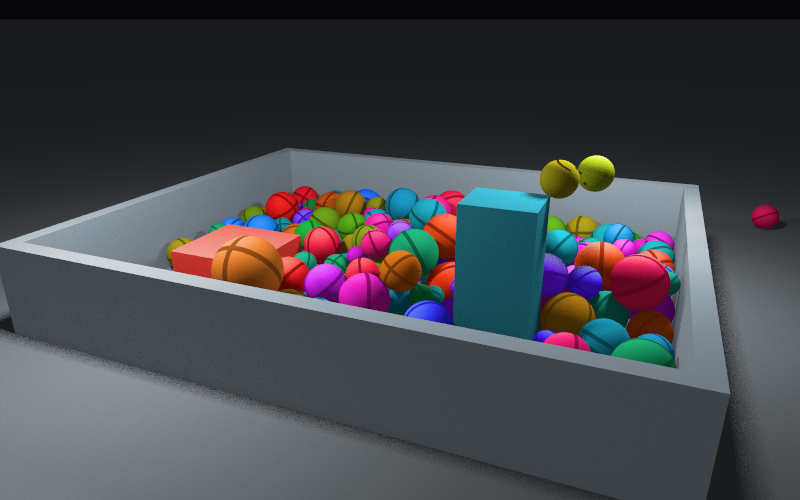
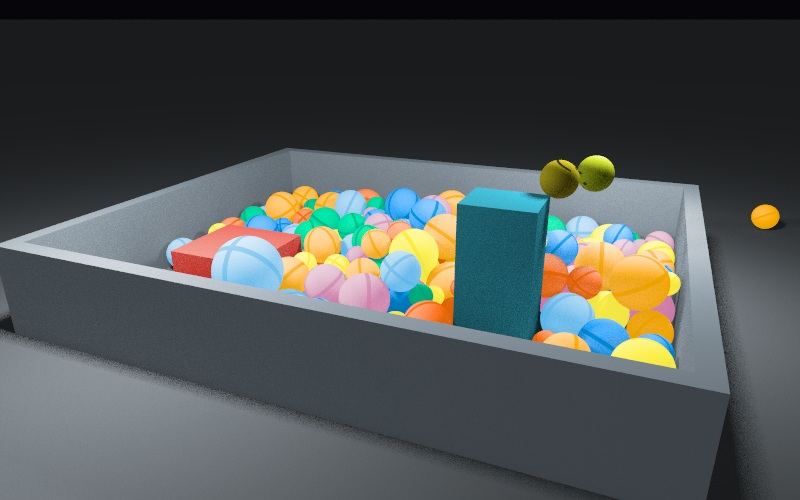
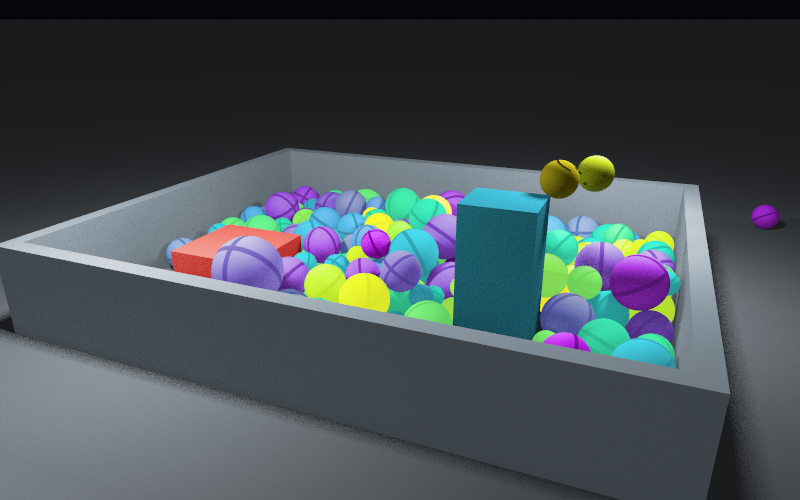
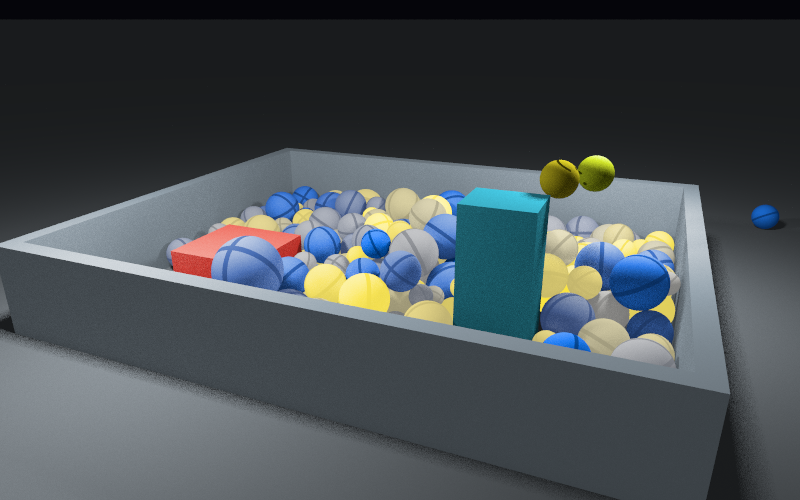
The direction
Where it is going.
The market
The markets it is built toward.
$8.35 billion by 2030
Game engines (Grand View Research). Forecast: 18.4% a year, 2025 to 2030.
$4.5 billion in 2025, $19.8 billion by 2033
3D rendering, with animation and VFX its fastest-growing use (Grand View Research). Forecast: 19.6% a year, 2026 to 2033.
$2.1 billion in 2025, $8.76 billion by 2030
Virtual production (MarketsandMarkets). Forecast: 33.1% a year, 2025 to 2030.
$7.21 billion in 2025, $18.03 billion by 2035
Real-time graphics and rendering (Market Research Future). Forecast: 9.6% a year.
What studios need
What studios ask of an engine.
Terms they can trust
After Unity announced a per-install fee in 2023, 7% of developers changed engine and 28% considered it; Unity withdrew the fee in September 2024.
No cut of a game's revenue
Unreal's royalty on a $10 million game is $450,000 at 5% of the revenue past its first $1 million, or $315,000 at 3.5% when it launches on Epic's store.
Any GPU, not one vendor's
Octane needs a CUDA-capable NVIDIA GPU, or Apple silicon as Octane X: path tracers lean on CUDA and OptiX.
Path-traced light in real time
Cyberpunk 2077's path-traced mode runs at about 21 frames a second at native 4K on an RTX 4090, and reaches about 100 only with upscaling and generated frames.